Photo: Daniel J. Cox
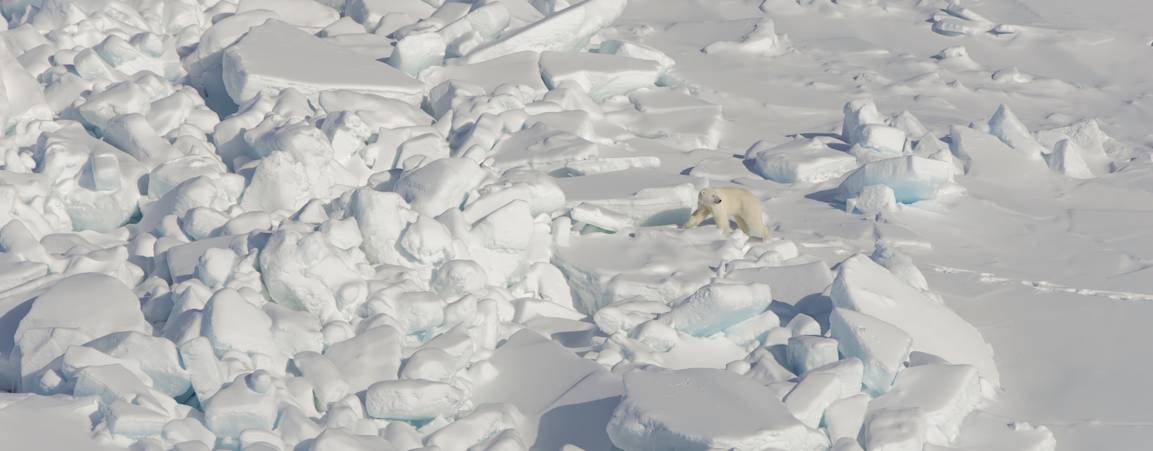
Southern Beaufort Sea Polar Bears
The Southern Beaufort Sea sub-population has historically been one of the best-studied populations in the world. That long-term monitoring has allowed scientists to document that persistent sea ice loss is leading to fewer cubs and greater energy use for adult bears, prompting a 40 percent decline in the population. Today, this effort is threatened both by changing environmental conditions that make fieldwork challenging, and by lack of federal funding to maintain this priceless data set.


Population size
819 polar bears (2021)
Status
Likely decreased ( IUCN Polar Bear Specialist Group (PBSG) )
Range
The Southern Beaufort Sea sub-population extends along much of the coast of Alaska, roughly from Point Barrow in the west to Tuktoyaktuk in the Northwest Territories, close to the US/Canadian border, in the east. In the south, it includes denning areas in the Arctic National Wildlife Refuge.
Trends
The population is believed to have increased from 1981 to around 2001 as it recovered from decades of sport and trophy overhunting, which was curtailed by the passage of the U.S. Marine Mammal Protection Act and The 1973 Agreement on the Conservation of Polar Bears. It declined significantly in the mid-2000s due to sea ice loss, and then regained some stability at a number roughly 40 percent below its initial recorded size.

Photo: BJ Kirschhoffer / Polar Bears International
A female polar bear emerges from her den on the North Slope of Alaska.
Behaviour and Natural History
The Southern Beaufort Sea is in the Divergent Sea Ice Ecoregion, in which currents pull sea ice away from the shore continually as it forms. During winter months, the ice that moves offshore is replaced by fresh ice that forms closer to the coast; in summer, the ice continues to move offshore but no ice forms to replace it, leaving a band of open water closer to land. Historically, that sea ice remained visible and even touched the shore in the summer months, while today it can be over 640 km (400 miles) offshore.
Enormous home ranges
As they travel across the retreating ice, bears frequently cover enormous distances. A 2001 study by PBI’s senior scientist emeritus Steve Amstrup and colleagues found that the average home range of 75 radio-collared females was approximately 57,500 square miles, although there was considerable variation, with some restricting themselves to areas as small as 1,158 square miles and others expanding across more than 230,000 square miles — an area almost as large as France.
Some specific aspects of the geography, topography, and sea ice dynamics of the Southern Beaufort Sea region contribute to the size of these home ranges.
The continental shelf — the shallow, highly productive area that extends from the coast — is relatively narrow. As the ice pulls away from the shore, it travels north over less productive ocean areas, and the bears must move constantly in search of an area where they can find and feast on seals. By late winter, when the sea ice has frozen fully, they make their way south to the more productive region along the coast.
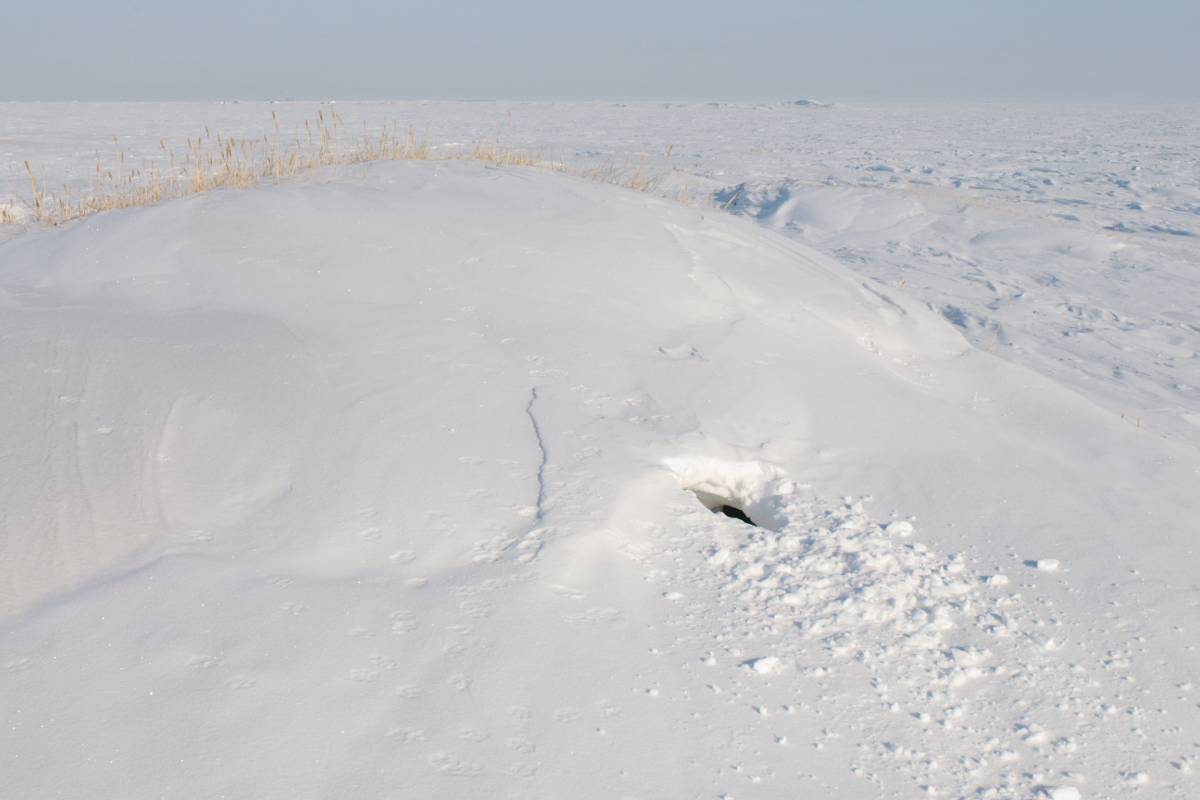
Photo: BJ Kirschhoffer / Polar Bears International
A newly opened polar bear den.
Overlap with other populations
Data from the 1980s and early 1990s indicate that adult female polar bears marked in the Southern Beaufort Sea spent about 25 percent of their time in the northeastern Chukchi Sea, and adult females captured in the Chukchi Sea spent about six percent of their time in the Southern Beaufort Sea. Because the principal area of interchange is in the area between Point Barrow and Point Hope approximately 300 miles to the west, there has been discussion among researchers about moving the western boundary of the Southern Beaufort population further westward to provide a more accurate representation of the populations’ distribution. Similarly, the eastern boundary was originally established farther east, but was moved to its present location in 2016.
More dens on land, fewer dens on ice
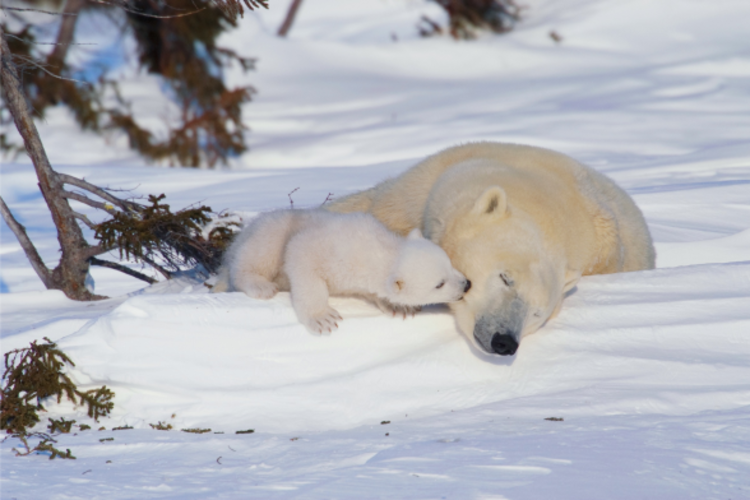
Pregnant females generally enter their dens in October or November, give birth in January or February and emerge in March or April.
Historically, up to half of maternity dens by the Southern Beaufort Sea polar bears were built on the sea ice. However, as the extent and quality of sea ice in the region has declined, so has this behaviour, to the extent that all denning now appears to take place on land. Females build dens in snowdrifts that settle along coastal, river and lake bluffs in the otherwise largely flat coastal plain. Conditions and topography appear to be more conducive to denning in the central and eastern part of the range.

Photo: Daniel J. Cox
Threats
As with most parts of the polar bear’s range, the human presence in the Southern Beaufort Sea region is sparse. However, the area is also home to significant and growing oil exploration and extraction.
Climate change
Population declines are driven by changes in sea ice cover as a result of climate warming. The ice-covered period each year has decreased by 17.5 days per decade since 1979, leaving largely open water for longer stretches, especially in coastal areas, and giving bears less time to feed. Additionally, thick multiyear ice has largely disappeared, replaced by first-year ice that is thinner and less stable. In addition to having less time to hunt, bears must spend more energy to travel greater distances to find suitable ice conditions.
Industrial activity
In addition to the obvious potential consequences for polar bears and the Arctic ecosystem more broadly of a catastrophic oil spill there is particular concern about denning polar bears being disturbed by the heavy equipment used in seismic exploration and drilling activities.
Given that denning on sea ice is seemingly no longer an option, dens are now being built almost exclusively on land, which brings them closer to this industrial activity. The purpose of building dens is to provide mother and cubs with a safe and comfortable environment in which the young bears can spend the first couple of months of their lives; any disturbance that forces the mother to abandon the den early essentially condemns the cubs to death. As cub loss has been a major factor in the estimated 40 percent decline in the population, any further impacts on cub survival would obviously be potentially highly deleterious. Such concern is only heightened by the prospect of oil exploration in the Coastal Plain of the Arctic National Wildlife Refuge (ANWR), which hosts the greatest concentration of den habitat in the area.
Federal regulations require oil companies to use FLIR (forward-looking infrared) radar to search for polar bear dens before beginning any activity, but a 2020 study by PBI and Brigham Young University found that these surveys failed to locate more than half the dens in a given area.

Coexistence
A very different consequence of human activity in the region is a growing reliance by bears on piles of bowhead whale remnants, the leftovers from subsistence hunting by Inupiat communities. In the town of Kaktovik, more than 120 bears — roughly 15 percent of the remaining population — have been observed feeding on carcasses at once. It is possible that the energy gained from such scavenging is preventing the Southern Beaufort population from declining more rapidly and severely, although the increased presence of bears in close proximity to humans raises risks for both.