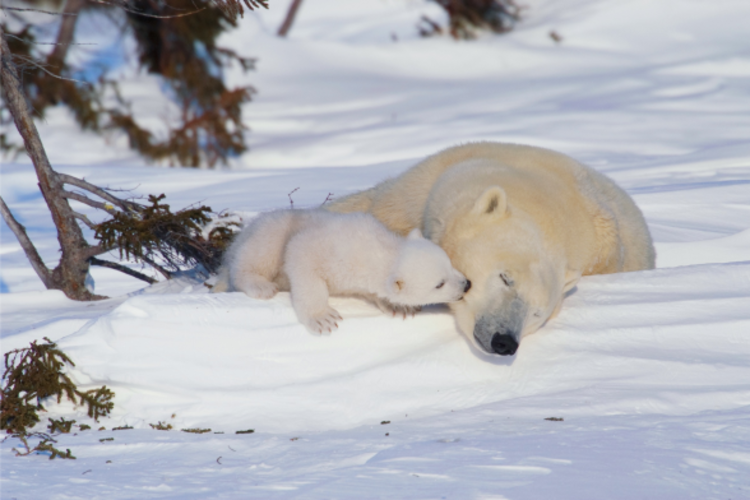


A female polar bear emerges from her den on the North Slope of Alaska

Photo: BJ Kirschhoffer / Polar Bears International

A female polar bear emerges from her den on the North Slope of Alaska.

The Impact of Government Polar Bear Programs: United States

by Kieran Mulvaney

MINS


09 Dec 2025

For more than four decades, the U.S. government has conducted an ongoing program of polar bear research that is among the most respected and productive in the world. 

Overseen by the Department of the Interior, the program has compiled an unrivaled compendium of information on polar bear population dynamics, distribution, energetics, and denning. Working primarily with the United States Geological Survey (USGS) and the United States Fish & Wildlife Service (FWS), U.S. government scientists have played a key role in polar bears being listed as threatened under the Endangered Species Act and have in particular yielded a wealth of data on the Southern Beaufort and Chukchi Sea subpopulations, data that has proven essential in evaluating the growing impact of climate change and sea ice loss on polar bear populations.

At a time when too many in power refuse to acknowledge the reality of climate change and question the value of government-supported scientific research, some of those who have been intimately involved in the program are keen to trumpet the program’s successes and express concern about what is at stake.

Over the years, says Scott Schliebe, who ran the U.S. Fish & Wildlife Service’s Polar Bear Program from 1980 to 2008, such research has yielded “a lot of valuable scientific information that we’ve used, for example, to delineate populations, to separate between Chukchi Sea and Beaufort Sea stocks. We have probably one of the top two most studied populations in the world, in the Southern Beaufort Sea. We've got data sets that go on and on, back to the 1970s, and just it's such an incredible wealth of information.” The idea that such research could be terminated is, he offers, “unsettling.”

Two young COY cubs in the mouth of their maternal den in Alaska

Photo: U.S. Fish and Wildlife Service

Why government-led polar bear research is vital

For Rosa Meehan, former manager of the FWS marine mammal program in Alaska, having research funded and conducted by the government is vastly preferable to relying on academic grants or private enterprise.

Answering fundamental questions

“In a government setting, as opposed to an academic setting, there's money that is dedicated to doing basic research,” she explains. “Academia is a really important partner in all this, but if you are in academia, you must have a philosophy. You must have something you're really working on, and that's what drives your research, whereas with the [U.S. government] and polar bears it’s more a case of, ‘Hey, we care about this critter, and we want to learn everything we can about it.’ It's perhaps a subtle difference, but I think it's important.”

In particular, she continues, a core component of government-funded polar bear work is ongoing monitoring of populations, which enables scientists to develop a picture of how polar bears might be affected by hunting, habitat loss, and climate change.

“Long term monitoring of animals was never done,” she explains. “You could never sell that in an academic setting. It’s a critical way to get information that you would not get through the academic route.”

The entrance of a maternal den in Alaska

Photo: U.S. Fish and Wildlife Service

The entrance of a polar bear maternal den in Alaska.

Neutrality

Governmental research, she continues, also carries an imprimatur of neutrality, unlike most other possible funding sources.

“The other big funding source [in Arctic Alaska] has been oil companies, and they’ve paid for lots of research and some of it has been really good. It’s been really helpful,” she says. “But it always has that question of, ‘Yeah, but it was paid for by the oil companies,’ and so you just need to be mindful about how you use it.”

Relatedly, adds Schliebe, is the fact that the government has a responsibility to every stakeholder, unlike other vested interests.

“Other funding sources, be it academia or industry, are providing funding for a particular reason. ‘I’m going to show that polar bears don’t occur here, so I can put my well here,’ or ‘I’m interested in this particular aspect of polar bear nutrition.’  If you’re going to deal with conservation, you have to have a broad perspective.”

Depth of experience

Another factor, adds Geoff York, Polar Bears International senior director for research and policy, is that having a continually funded study for so many years means there is a vast breadth and depth of experience and familiarity with the region.

“People develop unique expertise,” he points out. “They develop unique relationships that also make the work feasible, but they also do the kinds of science that academics can't:  monitoring diseases, responding to unusual mortality events, along with that long term data collection. So, there are aspects to what government does that just aren't easily filled by the private sector or others.”

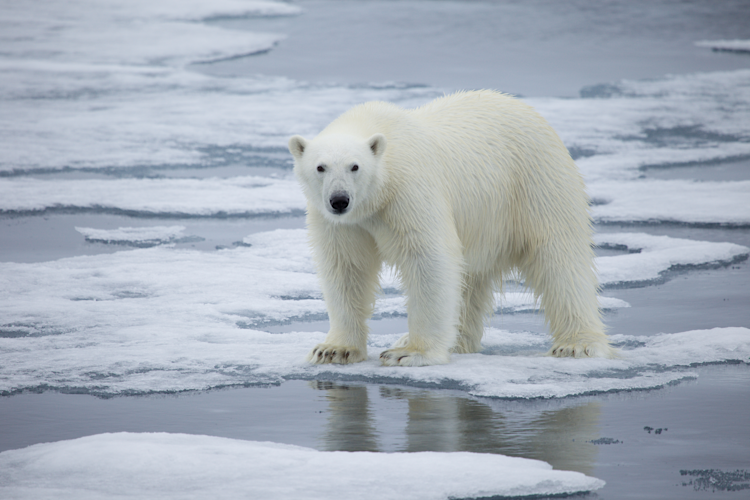
A polar bear walks across broken ice floes in Alaska

Photo: U.S. Fish and Wildlife Service

U.S. government, polar bears and the Endangered Species Act

All these elements — the breadth and depth of expertise, years of baseline research, government’s role as an honest broker — came together in 2008 with what Schiebe and Meehan both consider perhaps the finest hour of government agencies’’ polar bear work: the review that led to the species being listed as threatened under the Endangered Species Act.

The review began after three environmental groups sued the George W. Bush administration in 2005, urging it to list polar bears because of the threat posed to their future as a result of climate change causing declines in sea ice. Schliebe recalls that the process was not something to which he was particularly looking forward.

“The last thing I ever wanted to do was know anything about the Endangered Species Act and jump in the deep end of that pool,” he reflects.

Then as now, the White House was, to put it mildly, skeptical about climate change and highly reluctant to take any steps to address it if it meant in any way limiting the actions of the oil and gas industry. But, says Schliebe, over the course of three years, teams at USGS and FWS led such an extensive process, with such wide input from peer reviewers and other stakeholders, and compiled such a watertight report, that the administration ultimately had to accept the recommendations.

“All of the research and all of the data that was compiled and went into evaluating whether or not we should list polar bears, all of the multiple approaches and different hypotheses, different ways of probing to find the answer, and it generated such an incredible wealth of information that when we put the listing together, despite the administration not wanting to list polar bears, despite their opposing it all the way down to the end, they really had no choice, because they were going to lose in courts if they didn't go with it,” he recalls.

Because of the administration’s position on global warming, adds Meehan, the final report was “wordsmithed so that it doesn't say climate change in it anywhere. It simply focused on loss of sea ice.” And, although the report faced pushback — from NGOs who wanted polar bears listed as endangered rather than threatened and from the administration, which was skeptical of the need to list them at all — such was the authority imbued in it by decades’ worth of studies and the thoroughness with which the report was compiled and reviewed, that ultimately all sides had to at least acknowledge the unimpeachability of the science.

A polar bear eating a meal in Alaska

Photo: U.S. Fish and Wildlife Service

An uncertain future for U.S. polar bear research

Seventeen years after polar bears were ultimately listed, the United States again has a presidential administration that rejects the science behind climate change, is actively cutting scientific research and key government programs, and is strongly supportive of increased fossil fuel production. Accordingly, the future of the polar bear program is, at least in the near term, uncertain. And there are concerns that, should such research be restricted or halted for even a finite period of time, it could be extremely difficult to once again ramp up the resources, the knowledge base, and the expertise to return it to its present level.

“Polar bears are occurring in a rapidly changing part of the world, and at the same time, there's a lot of development interest in this rapidly changing part of the world,” Schliebe adds. “And if you want to try and manage the development in a responsible way, then you have to understand how the environment works and be able to track what the environment is doing and what changes are happening in the environment.”

“You know, bears have been around forever,” offers Meehan as a closing thought. “We’re a Johnny-come-lately on the scene, particularly up in the Arctic. Obviously, there have always been Indigenous folks up there, but more generally, that intersection between polar bears and humanity is relatively recent. I just feel it's our responsibility to look at it, understand it, and address it in a thoughtful fashion.”

Kieran Mulvaney is a freelance writer who has written extensively about polar bears and the Arctic for publications including National Geographic, The Guardian, and The Washington Post. A native of Bristol, England, he lives in Bristol, Vermont.