Can you give us an example of the difference between evolutionary change and adaptive change?
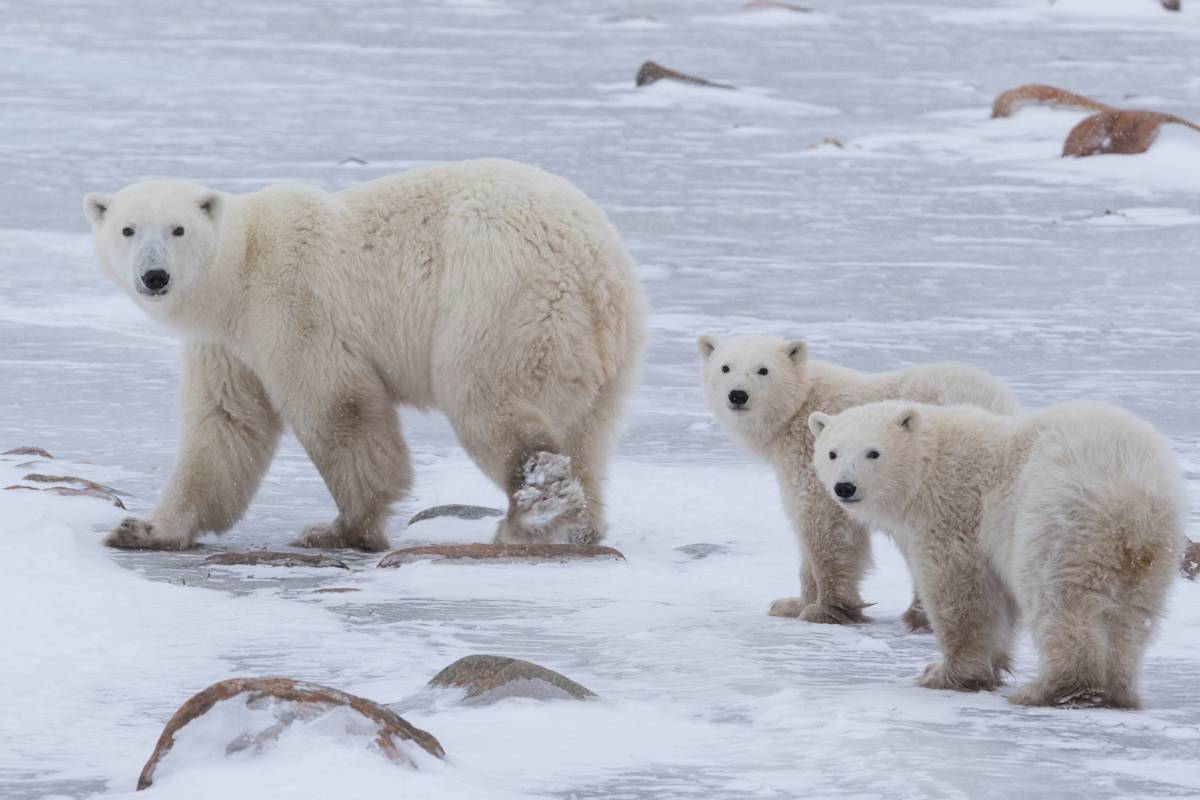
Ruth Rivkin: Sure. Body size is a good example of an evolutionary change that’s probably not adaptive for polar bears. Polar bear body sizes have declined in several populations over the past 30 to 40 years. We don't think the change is adaptive, though, because larger bears produce more cubs and have better survival rates than smaller bears. It’s well-documented in populations where the bears have become smaller that there hasn’t been a corresponding increase in the number of cubs or survival rates. This suggests that while there is an evolutionary response happening, it's not an adaptive response.
In addition, we know in at least one of those populations, Western Hudson Bay, that there's very little genetic variance, which is an essential component of adaptation. Now, polar bear responses are not equal across the Arctic. There are parts of the Arctic where polar bears are actually doing quite well. Their population numbers are stable. They have good cub survival rates, and cubs are growing into adults. But we don't have data on how those populations are changing physiologically or genetically through time, and so there's this big unanswered question about what’s happening in those populations.
Earlier, you mentioned behavioural changes that are benefiting some populations. What are some examples?
Geoff York - As Ruth said, polar bears are very smart and capable of adapting their behaviour — a genetic feature in itself. Polar bears range across a massive area with a great deal of habitat variation. As the Arctic continues to warm, they’re going to respond in different ways in different places, which in the short term is good news. A great example of that is in southeast Greenland, where the polar bears and seals have changed from using sea ice to using freshwater glacial ice. We're seeing that a little bit in Svalbard, too, with a shift in prey, both with the bears hunting different types of seals, but also with hunting Svalbard’s small reindeer on land. Also in Svalbard, some polar bears continue to follow the pack ice as it retreats in summer, but we’re also seeing a small group of bears, about 200-300, that have decided their best strategy is to stick around the island, making the best of what they have, where they are.
Were there any findings in terms of polar bear population boundaries? Could these lead to redrawn maps?
Geoff York: We currently recognize 20 different polar bear populations. But some of the boundaries were drawn more for political and harvest management reasons, especially in areas where we lacked good movement data. But now we have genetic data that is much more robust in terms of defining groups of bears. Canada’s Hudson Bay region is a good example. Genetics can help us determine whether we do, in fact, have multiple populations of polar bears in Hudson Bay (currently defined as Western Hudson Bay, Southern Hudson Bay, and Foxe Basin) and, if so, where the boundaries are. The same holds true for other parts of the Arctic.
What would a genetics-based management plan look for polar bears? Can you give us an example of what might be included?
Ruth Rivkin: Absolutely. We know that genetic variation is critical to evolution and that gene flow happens through dispersal. So polar bears moving widely across the Arctic can help buffer some of the negative effects of habitat and sea ice loss. A genetics-based management plan would include a focus on maintaining movement corridors — being really careful about where we assign shipping lanes, for example — and preserving as much habitat as we can. Maintaining that connectivity is one of the most clear-cut ways to help preserve polar bears in a warming Arctic. A genetics-based plan would also look at harvest levels from a genetics perspective and use genetic indicators to assess a population’s health. Genetics provide a tangible, measurable way of assessing sustainability and long-term evolutionary potential.
The paper also talks about the importance of including Indigenous knowledge in management plans for polar bears. Can you talk about that?
Ruth Rivkin: Polar bears are an integral part of northern Indigenous cultures. They are essential to a community’s sense of well-being and identity. Working with Indigenous communities to help guide our strategies is something the field has already begun to do and needs to continue doing. As scientists, managers, and conservation planners, we need to make sure that we’re including and recognizing Indigenous knowledge sources and that we’re weaving Western and Indigenous knowledge together to create a more holistic picture of what's happening with the bears. Integrating Traditional Ecological Knowledge with Western knowledge needs to be the focus, not only of research projects going forward, but also of management plans for the polar bears.
Geoff York: One interesting aspect of genetics research is that we can involve communities in helping to collect genetic data — by setting up hair-snagging stations, for example, along coastlines and collecting the samples. We’ve already started supporting this work in places like James Bay and Foxe Basin, and the findings are helping to inform our understanding of the bears in the Hudson Bay area. Going forward, there’s a tremendous amount of potential for working together to ensure populations have the best possible chance.