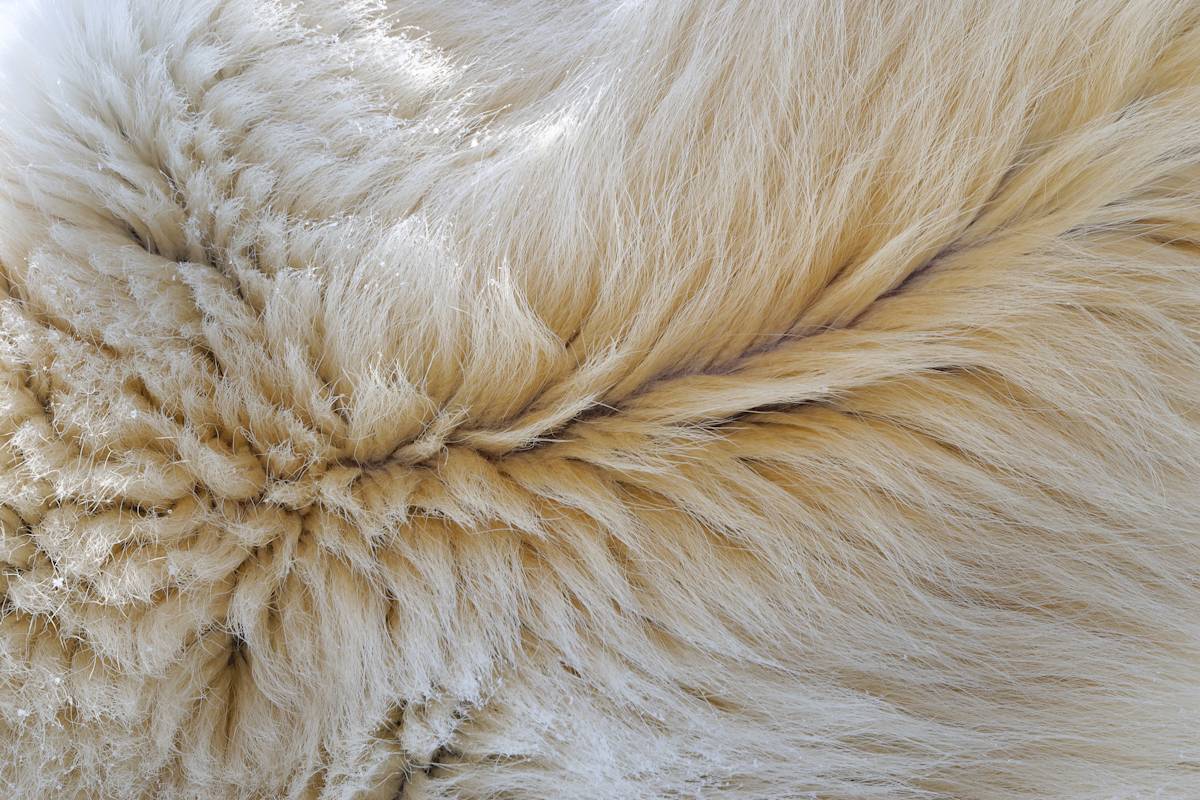
Photo: Daniel J. Cox
Reading a polar bear’s past in its fur
MINS
19 Dec 2025



Scientists have long thought that polar bears grow fur once a year, in summer. But as a new study shows, polar bear fur can grow as early as February. Why does that matter, and what can we learn from polar bear fur? We talked to study co-author and Polar Bears International Chief Research Scientist John Whiteman.
Why does it matter when a polar bear’s fur grows?
Polar bear fur is very important, and not just for insulation. It also can tell us things like how much stress they’re experiencing, or what kind of foods they’re eating.
When polar bears grow fur, the new hair traps molecules that are circulating in their bodies at that time. By collecting a fur sample and analyzing those molecules, we can learn what the bear was doing when that fur was grown, which could include important activities like hunting out on the sea ice. But until now, we did not have good evidence of just when that growth was occurring.
What role does fur play in what we can learn about polar bears?
Fur can help us answer a lot of big questions about how polar bears are being affected by climate change and ice loss — like whether they’re changing what they're eating, or when they're eating it. But to answer those questions, it’s really important to know when that fur was growing and incorporating that information.
For example, in Greenland, we’ve been able to see links between long-term changes in climate, sea ice, ocean and wind currents with indicators of stress in polar bear fur. And in northern Alaska, where sea ice is retreating further and further north in the summer, polar bear fur is reflecting a divergence in behavior where more bears are spending longer periods on shore, whereas other bears are following that ice far from land.
What’s new and different about this report?
Previous studies about polar bear fur growth have assumed that new hair is only grown in the summer when the bears shed their old fur and start growing new fur for the coming winter. But researchers hadn’t yet tested that assumption by sampling bears earlier in the spring, so it was a big surprise when we sampled a zoo polar bear in February and found that it was already growing new fur.
We know so little about polar bear biology during the heart of the Arctic winter because it's really hard to go out into the field and study wild bears in December, January, and February. It's dark, it's so cold that helicopters often don't work, and you would not even be able to see the bears. But now that we know their fur can be growing as early as February, that means we can potentially learn more from fur samples about what’s happening that time of year.
February is around the time of year when polar bear body condition is at its worst. Although there's plenty of sea ice during the winter for them to be traveling on and hunting, it's also dark and windy, and seals spend little time on the sea ice surface. We have a strong suspicion that their hunting success is pretty low during that time of year. Now we know that if we collect a fur sample in, for example, April, the newest section of that hair may have grown in February - rather than last summer, as we had been assuming — and it could be analyzed to gain more insight about their nutritional condition.
This research was conducted with zoo bears — how can zoos contribute to wild polar bear conservation?
This project highlights the really important partnership that zoos can provide. A zoo provides continuous access to individual polar bears, meaning we can study them in a controlled environment and take fur samples at predictable time intervals.
There's no way we could do this study with wild bears alone. For example, for our methods, we had to apply a little bit of dye as a visual marker on the fur and then come back and sample that same dyed spot weeks and months later. You could put dye on a wild polar bear’s fur, but then you're definitely not guaranteed you're going to be able to find that individual later.
How does one dye a polar bear?
This study is a nice example of the unusual techniques that are sometimes required for science. We used cosmetic hair dye — the same kind you’d find in a beauty salon — to mark a spot on polar bear fur. Then we went back weeks and months later and we could watch that patch of dye on the fur advance as the fur was growing over time. If you ever dye your hair and then get annoyed when your roots grow out, that's exactly what the polar bears were experiencing as well. We also fed the bears a tiny dose of an inert molecular tracer - a unique amino acid - and it became trapped in the fur as it grew, generally matching the growth estimations provided by the more simple dye approach.

Photo: Jennifer Stern
Photo reproduced from Figure 1 in Stern et al. 2025.
What’s the impact of these findings on other species and ecosystems?
This study also included brown bears and American black bears, providing similarly useful information for these species. In fact, this study provided the first-ever measurement of growth in American black bears. Both species showed distinctly seasonal patterns — rapid growth for American black bears in June-July that ceased during August-October, and growth in May but not by June-August in brown bears.
Could this change the way we study polar bears?
This research helps expand the methods that scientists use to collect information on bears. For example, we can collect fur that was shed by a polar bear; or put out a barbed fence in places where bears congregate so they will rub up against it and leave strands of hair. Previous studies have already used this approach, doing things like amplifying the DNA from the fur to identify relatedness between bears and whether or not the same bears are returning to the same place. But now when we measure physiological information in fur, such as levels of stress hormones or dietary information, we can do a much better job of pinpointing the time period that we are learning about for that bear.