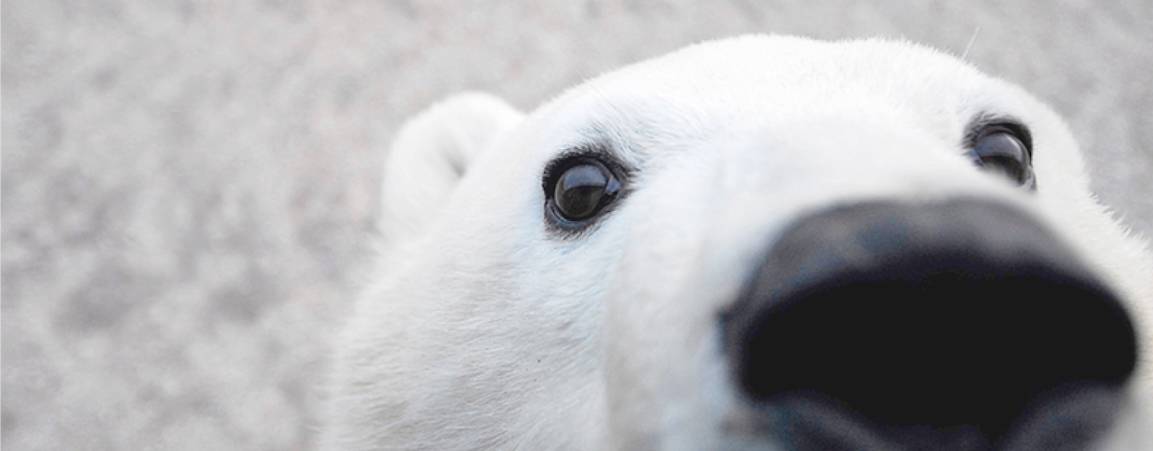


A mother polar bear and her twin yearling cubs walking on land

Photo: BJ Kirschhoffer / Polar Bears International

A year in the life of a polar bear

MINS


05 Jan 2026

Last October, as the temperatures dropped around Canada’s Hudson Bay and sea ice began to form, the area's polar bears stirred.

In Wapusk National Park, southeast of Churchill, Manitoba, Anuri, a 25-year-old female with an almost two-year-old cub, roused herself from a summer-long torpor. Neither she nor her offspring had eaten since coming ashore when the ice melted in July, and the pangs of hunger were making themselves felt.

For the next several weeks, they did not travel far, making their way up the coast to the promontory known as Cape Churchill, turning west — still hugging the shore as the early sea ice began to spread out into the bay — and then, in early November, heading out onto the frozen Hudson Bay and away from land.

Further north, on the Nunavut coast near the community of Arviat, 13-year-old Betty White and her two cubs-of-the-year were beginning their own journey toward the sea ice. Likewise following the coastline, by November 15 they were east of a small bay called Whale Cove; a few days later, they made a sharp right turn and made a beeline onto the ice.
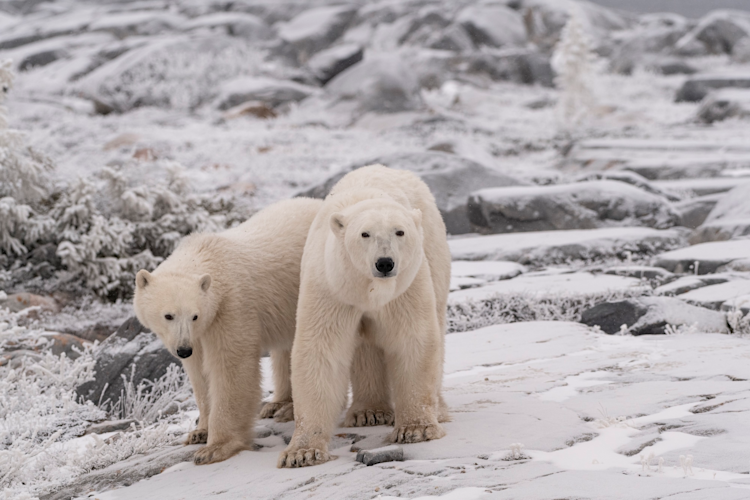
A mother polar bear and her yearling cub

Photo: Jenny Wong

Similar to this mom, Anuri had looked after her cub and nutured it for almost two-and-a-half years. Now, the presence of single-minded adult males, and its mother's sudden indifference, signaled to the cub that it was time to move on and begin its own life.

Wandering is what polar bears do, frequently over what are, to us, mind-boggling distances. They wander because they must, because their sea ice landscape is constantly changing, literally shifting beneath their feet, opening cracks to the water below and then closing them up again; and because as seasons change, so does the availability of their seal prey. And because the seals will not come to them, they must go in search of the seals.

The polar bears’ ability to cover vast distances, combined with their inhospitable environment, makes it extremely difficult for researchers to observe them at length in the wild — and effectively impossible during the long, dark winter months. Fortunately, it is possible to track female bears with the use of satellite collars that transmit location and some other data for a couple of years before they automatically fall off. (The necks of adult males are too thick for collars, which is why Polar Bears International has been leading and supporting research into other options, such as temporary “Burr on Fur” tracking tags and ear tag transmitters.)

Where are they now?

Follow Anuri, Betty White, and many other bears on our Polar Bear Tracker. It’s updated regularly with new information on the bears’ whereabouts.

Late fall is a time for polar bears to fill their empty stomachs as they crisscross the ice in search of leads (large cracks within an expanse of sea ice) and breathing holes through which they can snatch the ringed seals that constitute the great majority of their prey. However, the bounty of fall soon bleeds into the relative barrenness of the Arctic winter. Temperatures plummet, the sun disappears and the wind howls across the ice. Cracks in that ice freeze over, and seals become harder to locate. There are times when even a polar bear can do nothing other than hunker down, find shelter and wait for the worst weather to pass.

But a polar bear has to eat, too, especially a bear with a cub or cubs. And so both Betty White and Anuri kept walking in search of food. They walked and they walked, crossing hundreds of miles until they were all the way to the east, on the opposite side of Hudson Bay from where they started. On January 29th, Anuri was near the southeast corner of Hudson Bay, among the Belcher Islands just north of James Bay; Betty White was a little farther north, off Quebec’s Ungava Peninsula, but still as far east as it was possible for her to be without leaving Hudson Bay.

Anuri's location around January 29, 2025.

It is not typical for Western Hudson Bay bears to head so far east in such an apparently direct fashion: Betty White, who was first collared in November 2022, had never done so before. But a clue as to the two bears’ reasoning can be found by overlaying their movements with sea ice maps of the bay, and comparing them with 2024. During the earlier winter, winds pushed sea ice to the west, so bears had no option but to spend most of their time on that side of the bay, closer to Churchill. But during the winter of 2025, ice was thick across the bay, except in the very easternmost areas, where it was broken up with multiple large leads: perfect seal-hunting conditions.

Betty White's location around January 20, 2025.

Dr. Andrew Derocher of the University of Alberta says that he doesn’t believe either Betty White or Anuri actively made a beeline for the eastern shore of the bay; rather, they most likely started walking in search of food, guided by the presence and quality of ice and the smell of seals carried dozens of miles on the wind, and just kept on walking until they either found what they were looking or realized they could walk no further.

“It's probably very much just based on the sea ice conditions in front of them, and maybe where the wind took them that day,” adds Alysa McCall, Polar Bears International’s staff scientist and director of conservation outreach. “Maybe they smelled something good, and when they went in that direction they found the sea ice was pretty good. It’s probably a case of choose your own adventure every day.”

There is, she adds, almost certainly a method to their wanderings.

Anuri's location around April 25, 2025.

“Polar bears generally walk perpendicular to the wind,” she explains. “And then when they smell something good, they'll turn upwind and follow that — unless a better smell suddenly comes their way.”

Derocher continues, “At some point they feel the pull” of their home range. Although Derocher and colleagues have found there is no evidence that polar bears return to the same spots on the ice year after year, they unquestionably know which areas have proven consistently bountiful; and by February, both bears were heading west. By March, they were in similar parts of the bay, offshore to the east of Churchill and environs. And here, more or less, they stayed.

Betty White's location around April 21, 2025.

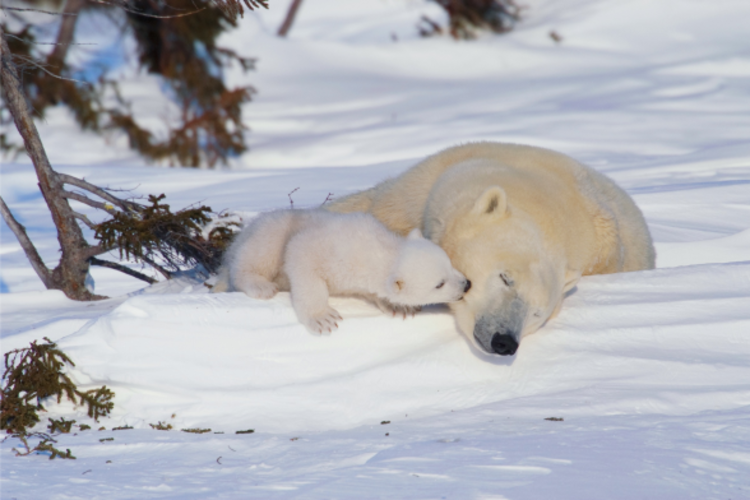
In March and April, the returning sun brings warmth and light and the Arctic comes to life. Polar bear mothers and newborn cubs emerge from maternity dens in the snow, and ringed seals build lairs on the ice to raise their new pups, in the process providing hungry polar bears with a landscape of seal meat, there for the taking.

Betty White and her two now-yearlings greeted this new season as a time of plenty. The youngsters watched and learned as mom made her kills, and they were likely old enough to make some of their own, with her help.

Anuri's location around July 16, 2025.

For Anuri and her cub, however, their relationship was reaching the end of the road. Anuri had looked after her cub and nurtured it for almost two-and-a-half years, and was now feeling the stirrings of a desire almost as old as life itself. She was once more ready to mate. As she signaled her readiness through pheromones released through the pads on her paws, eager males tracked her scent across the ice by following her footprints. The presence of single-minded adult males, and its mother’s sudden indifference, signaled to the cub that it was time to move on, to reluctantly strike out by itself and begin its own life.

Betty White's location around July 15, 2025.

By mid-summer, the ice in Hudson Bay almost completely melts, forcing the polar bears to begin coming ashore, where they remain on land until the ice returns in the fall. For Betty White and her cubs, the thaw marked their final summer together, a final fall and winter spent out on the ice, and then a parting of ways.

For Anuri’s cub, the summer was an anxious time as it navigated life by itself for the first time. It had to learn where to rest, where to go, what to avoid and how to survive on its own four paws. The next year or so will likely be the hardest and most hazardous of its life.

If Anuri mated successfully again, she won’t head back onto the ice in fall. Instead, she will make a den for herself and, in the depths of winter, give birth. In the warm, dark den, she will nurse and nurture her cub(s) until springtime, when they will emerge into the daylight together for the very first time.